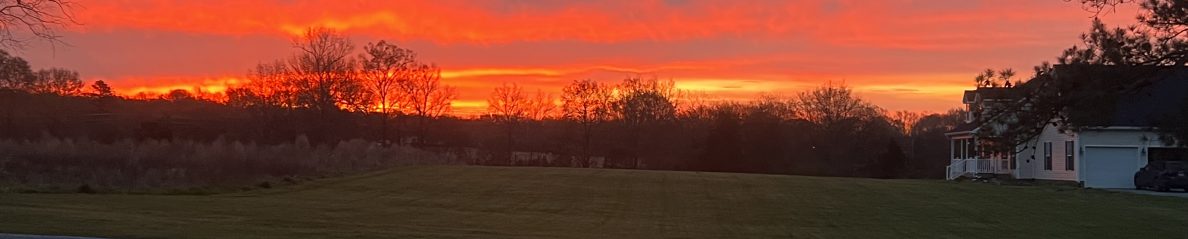
So, first – I cannot believe it has been almost half a year since my last post! I do know life has been hectic, especially when adding in Ms. Florence and Mr. Michael, who brought their water and wind to our little homestead, and caused us to have to patch the place up a bit.
Saying that, I wanted to talk about what I’ve learned owning chickens since the summer. We started out with eight chicks, lost some, had to process the roosters (first time I’ve ever killed anything, and it was a little traumatic), and brought an additional seven hens into the flock. I have also nursed one of my favorite hens, Ms. Mary (after Mary Poppins – my sister named her), back from the brink of death thanks to our pest control company putting down granules instead of spraying our yard for bugs the last time they came out. (We still use them for termite stations, but won’t be using any pest control going forward, for that and various reasons).
There is so much to talk about. I’ve learned so much, and I love my chickens. In fact, I’m pretty sure I’ve personally talked around half a dozen people into getting chickens themselves.
Going back to the beginning… I wish I had not started with straight run chicks. The types of chicks you can generally get are sexed female (pullets), sexed male (cockerels), and straight run (mixed bag).
For me, I knew it was better to get the sexed hens, because I had researched prior and knew you don’t generally want more than one rooster per ten hens. They get to be hard on the girls, and having more than one creates macho issues, like dominance, territory, and the like. So, initial plan (because we didn’t have a local hatchery, and because I was scared of ordering chicks through the mail), was to pick up some straight run chicks from a backyard hatchery in South Carolina.
The lady was a sweetheart, and gave us a lot of free information. She did tell us that if we ended up with too many roosters then she would process them and take them back. At the time I was pretty anti-processing (aka butchering). I thought…these chicks are for eggs. If I have too many roosters I’ll just find them a home. Problem solved!
Except…it wasn’t. What I don’t see a ton of online is the fact that in real life, finding a home for a rooster is next to impossible. No one typically wants to have just a rooster, and if they do then they already have one. If you try to find a butcher most will laugh at you. The last place I called (had 5 stars on Google) said that they had not processed anything since 1995 and now order their meat from a slaughterhouse, and only cut it for sale.
Seriously, no one butchers chickens unless it is theirs, and even then chickens have gotten so cheap in the agri system that most people just want to buy them at the store anyway. Did you know that there was a period of time that having a real chicken was considered a sign of wealth?! Not anymore, apparently!
You can go online and find USDA Processing Plants, but the closest one that agreed to do OUR chickens was an hour away and had a 20 bird minimum. I had two roosters that needed to go, so this was not an option.
So, after begging everyone I knew to take the guys off our hands (to no success), I then realized I had two options – drop them off somewhere, or process them ourselves.
I should add in here that I didn’t like the idea of giving them to someone to process just for them to eat. I figured…we are trying to homestead and learn life skills. Why should we give our hard work to someone else to eat because I’m a little squeamish? I did find one person on Facebook who agreed to come get them a few times, but he never showed. Telling you… it may sound minor now, but at the time it was a major conundrum to me!
So, I youtubed the heck out of processing chickens. We plan to use kill cones if we ever (lord forbid) have to do it again (I really hope we don’t).
So, in retrospect, if I had waited for sexed chicks, I may have not had this issue, or had had less of one…then again, sexing chickens is very iffy sometimes, so it would not have been a guarantee.
If you decide to get chickens then I strongly recommend adopting/buying pullets (young hens who are not laying yet), or young hens, and maybe save a rooster’s life by buying a young cockerel. At this point you know what they are. Otherwise, have a plan for the extra roosters, because you will almost definitely have this pop up at some point.
I am not going into a lot of detail on the actual processing until I get better at it, but I will say the first time absolutely stunk. We processed them ok, except I knicked the intestine on the first one, and ruined it. I’m planning to take a small processing class in the spring at our local extension center. I also felt heavy guilt for a few days after, and even now. One of my favorite roosters was processed that day, but due to us raising three at once they had started to get aggressive, so he had to go. I wonder if I could have kept him and he would have calmed down, but that is one decision you don’t get a do over on!
That’s probably the worst thing we went through with them, but the highs definitely outnumber the lows, so stick with me.
Our initial coop setup was actually pretty effective. I’m not going to say we are going to win awards on our run build, but we build a good coop that should last, and that has, so far, not been breached by predators.
There is a lot of info on run builds out there. If you aren’t that good with DIY (like we weren’t) then I’d suggest buying the actual coop to start, and building your run, which is much easier. Then you can build your skills little by little. Best advice I found – use 1/4″ gap or less hardware cloth (it WILL take two people and is a major pain, but is much much stronger than anything else – remember the more work you put in upfront is the less you have to upgrade later). Also, run the cloth under the dirt and about a foot or two out and bury it. This deters diggers. Lastly, do not leave any holes. Our only current coop mate is a very lucky mouse. If the chickens find out, then he’s toast!
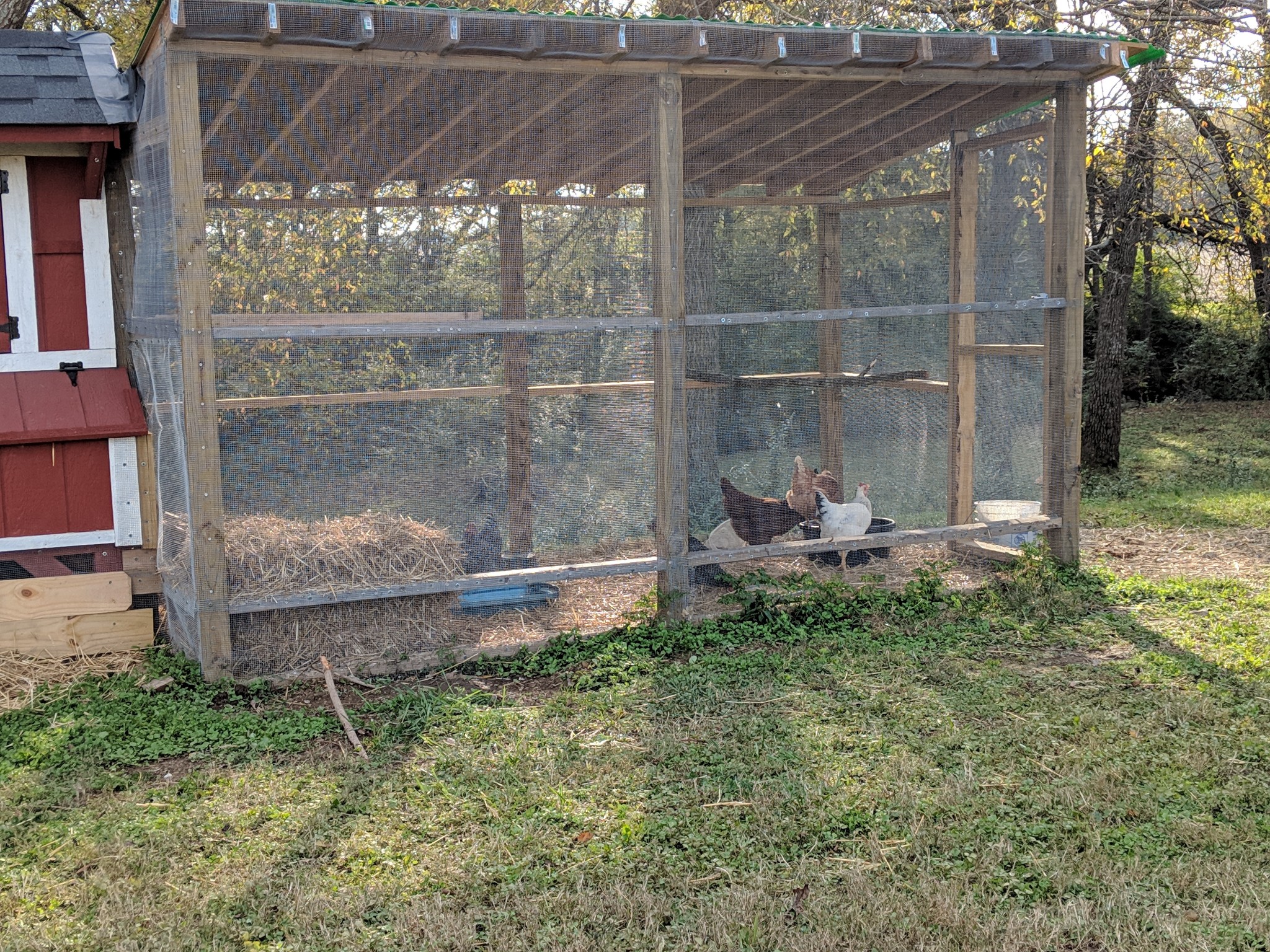
Our chickens had their run for a few months before we realized they needed perches. We added some regular tree limbs with long screws, and the girls couldn’t be happier.

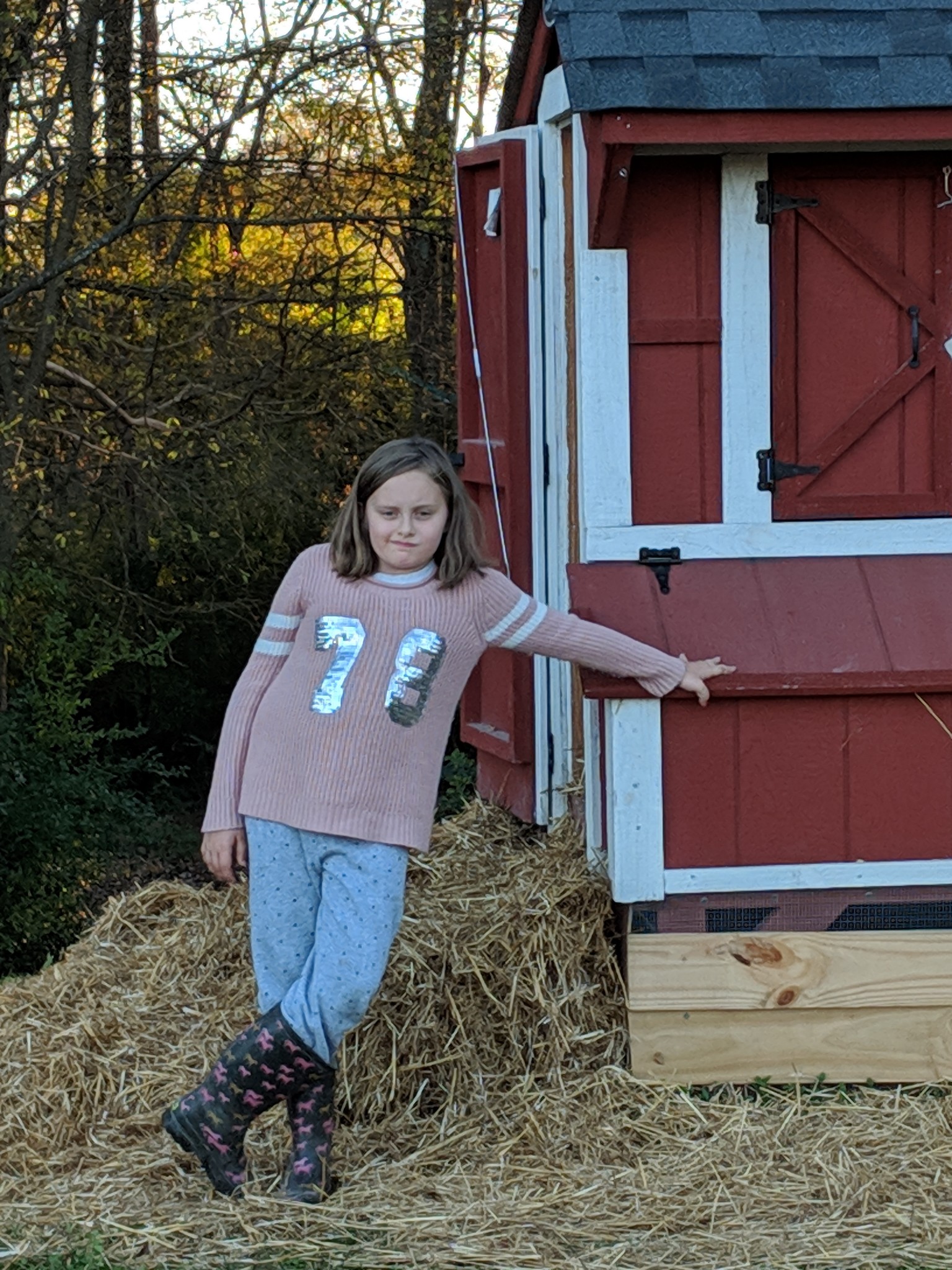
Here is Abby proud of her little flock, just like me.
A month or two ago we finally started getting eggs! The more recent ones have much more orange yokes, and I try to give them carrots to help. However, no matter what color the yokes are, they are delicious, and nothing replaces the feeling of knowing you raised the chickens yourselves, and that you know exactly where your food is coming from.

I thought when we got chickens that the eggs would last a month on the counter. They can (although I would definitely say use the water test – put them in water – if they sink, they are fresh. If they float, toss em), but only if you don’t wash them.
Personally, sometimes they’d get a little guck guck in the coop, so I always wash mine and stick them in the fridge. I ask friends and family to hold onto their cardboard egg cartons. It’s also really rewarding to be able to give friends and family fresh eggs!
We are currently getting about 3-5 eggs a day from our hens, with the occasional missed day. Per my research, egg yields during the winter are about half of what they are in the summer, because a hen needs 9 hours of sunlight to produce an egg. Since I have 10 hens, I’m pretty tickled that we are getting around 8 eggs every two days!

The egg sizes aren’t always uniform. The newer layers lay smaller eggs. Depending on the breed (and hen), they may be different colors and have speckles, or be a solid color. We said that we had a “Coneheads” egg last week, because it was narrow and tall. If we wanted to sell our eggs I think we’d generally be fine, but if we sold a lot then we’d need to grade them, and I’d have to research that more. I don’t currently intend to sell ours. I have just enough for friends and family, and I like being able to give them out. That may change if we add more chickens.
So, based on my luck with the chickens I decided to try our hands at ducks. I’d read that they were a little different, but that they were alike enough that you may be able to keep the ducks in the run. They don’t technically like roosting in a coop with chickens (more on that in a minute).
Who am I kidding? I saw a brooder of duck chicks at Tractor Supply in late summer and talked hubby into letting me get two. He said we could have them if they would live in the run and he wouldn’t have to build another coop. I don’t think he realized they could until it was too late! HA!
So, we came home with two cute little baby ducklings. I love my remaining duck, but I would not do it again!!!
Chicks are much cleaner than ducklings. You put in some chick starter, some water, some paper towels, and they are happy. They don’t like getting too wet, and their poop becomes solid-ish pretty quick.
Ducklings, however…. jeez. They LOVE water. They want to mix their food and water constantly, and they have to have water deep enough to clean their bill, so you can’t try to limit the size of the water feeder spout. Basically, I had two little ducklings who would love to muddy their water, and they would use it as a pool when they were older. It was a MESS. We quickly moved them from a brooder to a bathtub, which made it worse. At this point, they also smelled, and the smell would permeate our whole house (we live in a one story). As soon as they hit four weeks-ish we put them in the run with the chickens, who were interested in them, but left them alone.
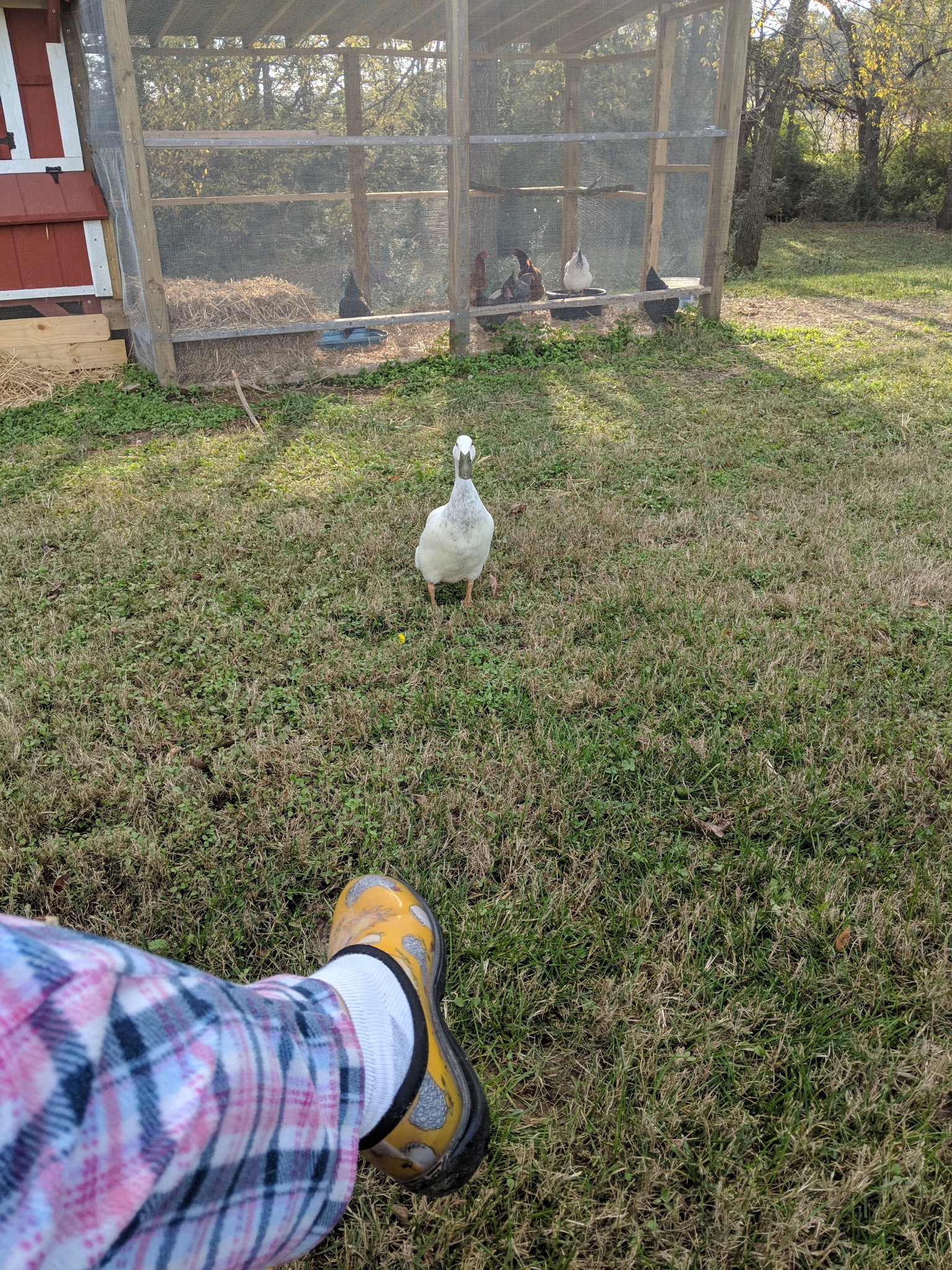
You are wondering why there is one, and not two, ducks in the above picture. We have lost a few to predators this year, which I expected, because they are free range. It still stinks, though.
We went a good few months without a problem, but started losing around a hen a week. Turned out, it was a coyote. That problem was solved, but we have lost a few more outside of that. I’m pretty sure that our losses this year were due to fox and the coyote, but I can’t rule out bobcat. I’ve been told that one was caught around here last year. Hawks are common, but I think the privet keeps the chickens away from their grasp. If a hawk was to get my full grown feather babies I’m pretty sure we’d find a body. We’ve only found one, and the rest were never located. The one we found had the crop eaten, and it had been chewing in the neck as well. Sad, but you learn quick that deciding to raise animals in the country will inevitably have some loss involved.
We thought about fencing in an area for the chickens, but my personal belief is that a fence would only give them a lack of places to run to. Instead of one gone, I could come out to several. I’d much rather give them a fighting chance, and let Rocky (our Australian Cattle Dog) out to help.
We started with 8 chicks….added 2 ducklings….adopted 7 pullets, and now have 11 chickens and one duck. We have lost five birds…four pullets and one duck. The duck hit me the hardest (as messy as they are, they are very sweet).
Before I get further… here is a photo of the ladies we adopted/purchased more recently. I had just gotten rid of our extra roosters, and was trying to boost our hen count to support the rooster we still had. His name is Dufus, because he has splayed toes, which is due to humidity issues during incubation (not genetics…I checked). I figured it might mean he can’t bother the ladies as much… haha…sorry Dufus. We don’t need more chicks – our rooster is mainly for watching the flock.
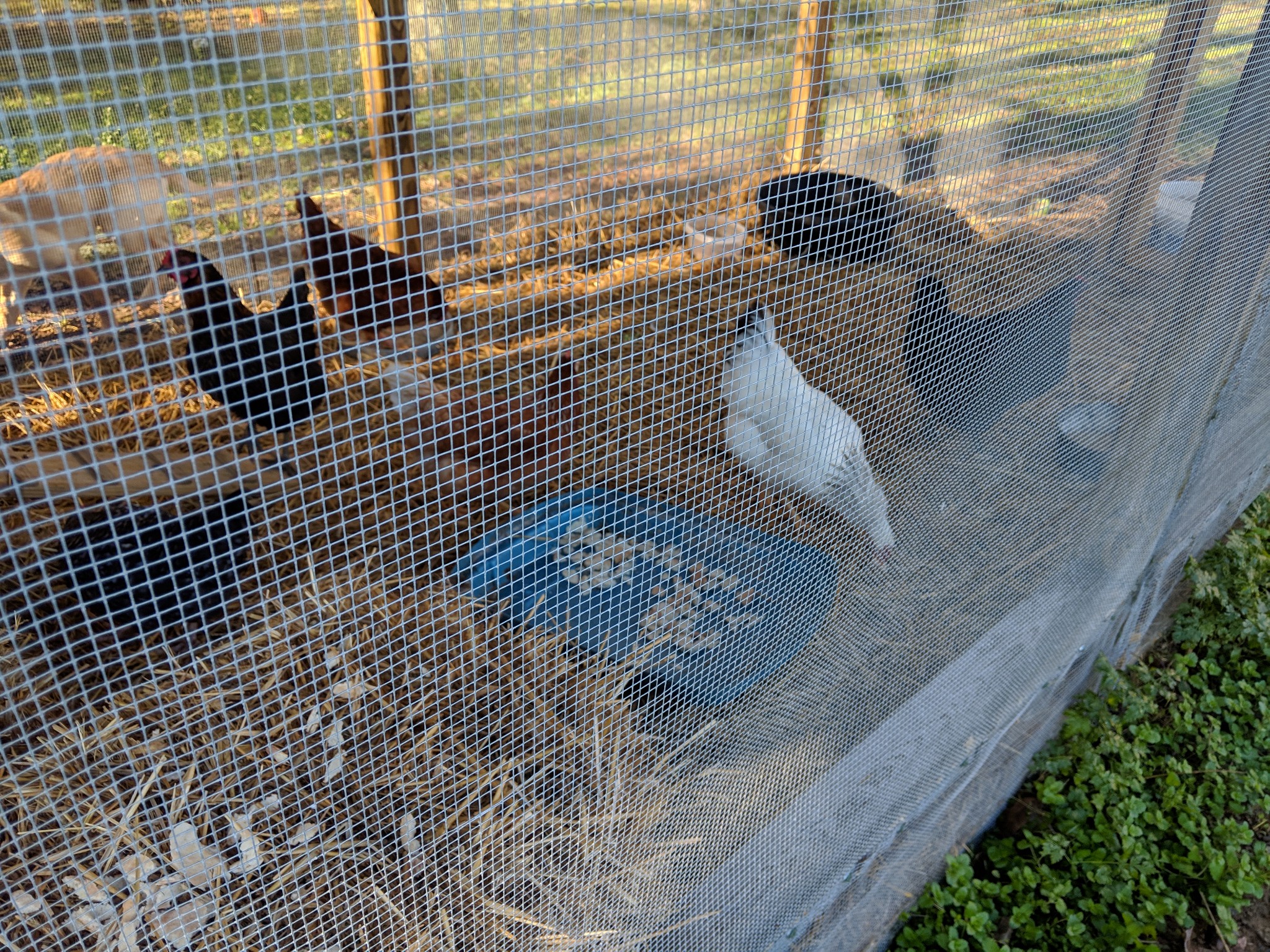
So, we learned A LOT this year. I like to think we have rolled with the punches, and rode the ups and downs pretty well. I have not had to deal with illness in my birds yet, but we did have an issue with pesticides (we now don’t use any pesticides around the house).
When we first moved in, we had a mouse issue. This has disappeared since we’ve been here. We still see the occasional one, but Charlie (our terrier), and the chickens keep the population pretty slim nowadays. In fact, one of the best bonuses of having the chickens is the lack of bugs!!!
We do not plan to be organic certified (because, honestly, I don’t plan to sell our food much, and if I did I think the certified think is a bit of a marketing stunt), but I don’t use pesticides on my food plants. I use Neem Oil. However, due to the spiders and ants and mice and such, we did contract with a pest control company when we first moved in. They would spray the yard, just like when we lived in the subdivision (in fact, it was the same company), and they would treat around the house. We also have termite stations just in case, because the fear of those things gives me the heebie jeebies.
One day recently, the rep used granules around the house instead of spray. I know it was because the weather was colder, and they thought they were doing us a favor, but they did not compute the birds, even though you can see the coop from our drive.
I walked out the next day to see my girls eating up the granules! I called in a panic, and was told that the product used was generally harmless to wildlife, except to birds and fish. I was simultaneously mortified and terrified. When we first signed up, the rep had told us that the toxicity was akin to toothpaste for predators, and wouldn’t hurt anything. Apparently, however, the fine print was that this was not true for all species, but was for dogs….as I found out the hard way. Needless to say, we no longer use pesticides around the house except for the termite stations, which are underground. We use chicken power, and Charlie!
The poison was water soluble, so I tried my best to water the granules down with a hose, but the birds still managed to get some. A few seemed sick, but pulled through, except for my Ms. Mary (my buddy). She’s a busy body, and like our duck, Apple, will follow you during the day, and loves to try to come in the house. I don’t let her, but I did this time. She exhibited diarrhea a few days later, and went downhill fast. When I finally brought her in she would not stand up, and the diarrhea was awful.
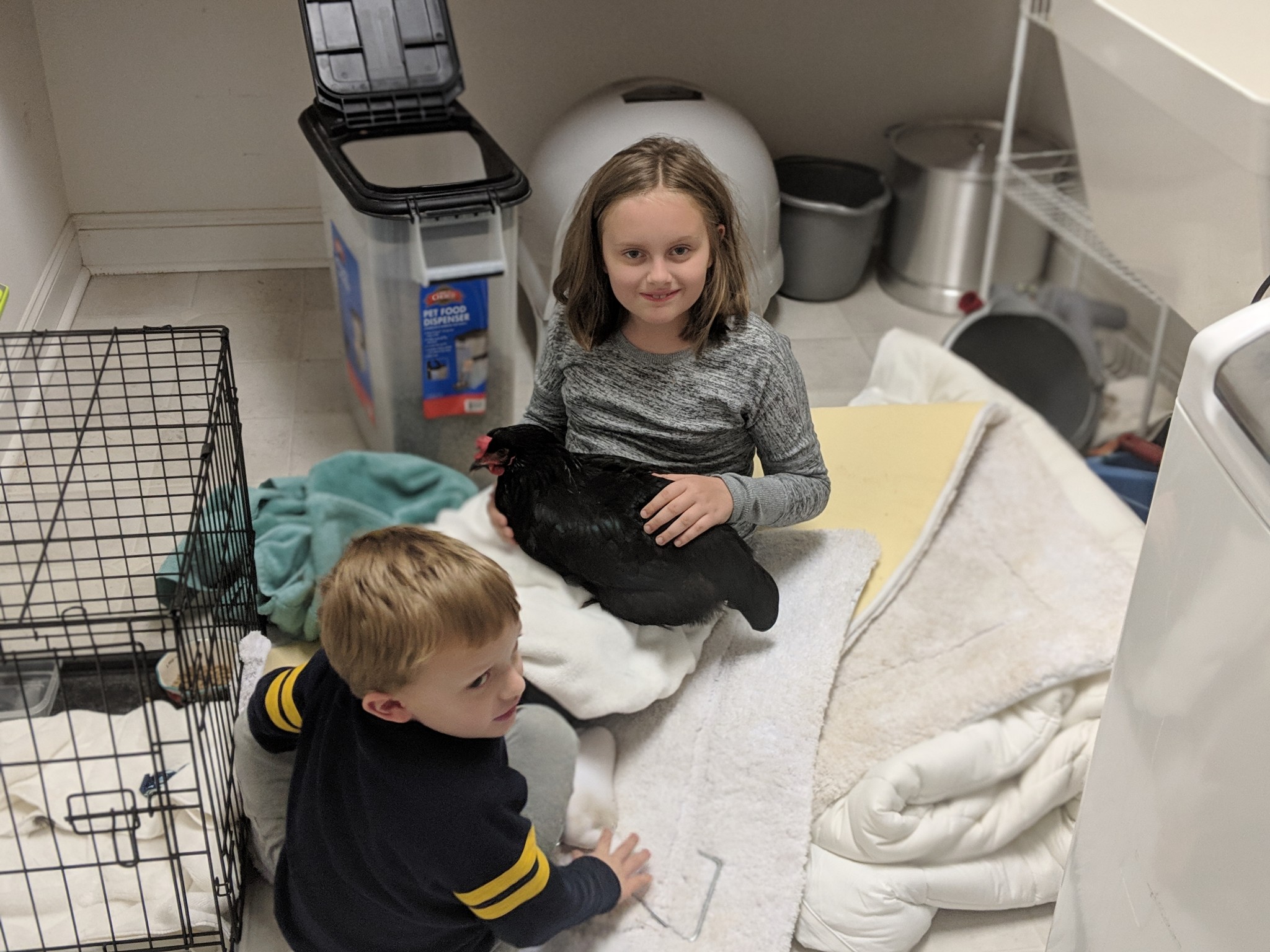
When I realized she was in bad shape we brought her in. The weather outside was pretty chilly to start with, so we added warmth by bringing her into the laundry. Then… I did something I never would have thought I’d have on my “did that” list.
I washed and trimmed a chicken’s butt. Seriously.
I was worried about pasty butt, where the vent becomes clogged and they basically die from not being able to poop, so I trimmed her butt feathers, and gave her a bath. She really enjoyed the warm bath!
Pasty butt is more common in chicks, but it can happen in chickens as well.
We then let her hang out inside. I even considered buying a chicken diaper and letting her be a house chicken, but between hubby’s horror, the price of chicken diapers being astronomical, and figuring she would be happier with her flock, I decided against.
Ms. Mary did recover. She is now back with her flock and happy as a clam.
On the subject of cold weather… that was also a new experience. You can buy heaters for the coop, but they can be dangerous, and chickens tend to generate a lot of body heat when they sleep, so I don’t use anything. I did switch from pine shavings that I used during the summer, to straw, and I think it insulates a lot better. There are people who may disagree on this, and they are entitled to. I researched, and decided on straw during the winter.
On the pine shavings bit, I don’t think I will ever go back, mainly because they are so dang messy. I plan to switch to sand in the spring/summer, because you can clean it like kitty litter, and they can use it as grit. I will still put straw in the nesting boxes, though.
Bonus – the straw can be put on our compost pile once it’s dirty. Right now, I’m piling a few layers of straw, and then when the floor gets high I scoop it out with our snow shovel and put it on the compost pile.
You may wonder why I have straw bales in and around the coop. That’s mainly to help our duck, Apple. See, since she lost her friend, Banana, she was lonely. Ducks are social creatures and need to be in groups. She has become an honorary chicken, and will climb the straw and sleep in the chicken coop! She stays warm and safe, and the chickens treat her like one of their own, but she can’t climb a chicken ramp, so I put down the bales. They also double as insulation.
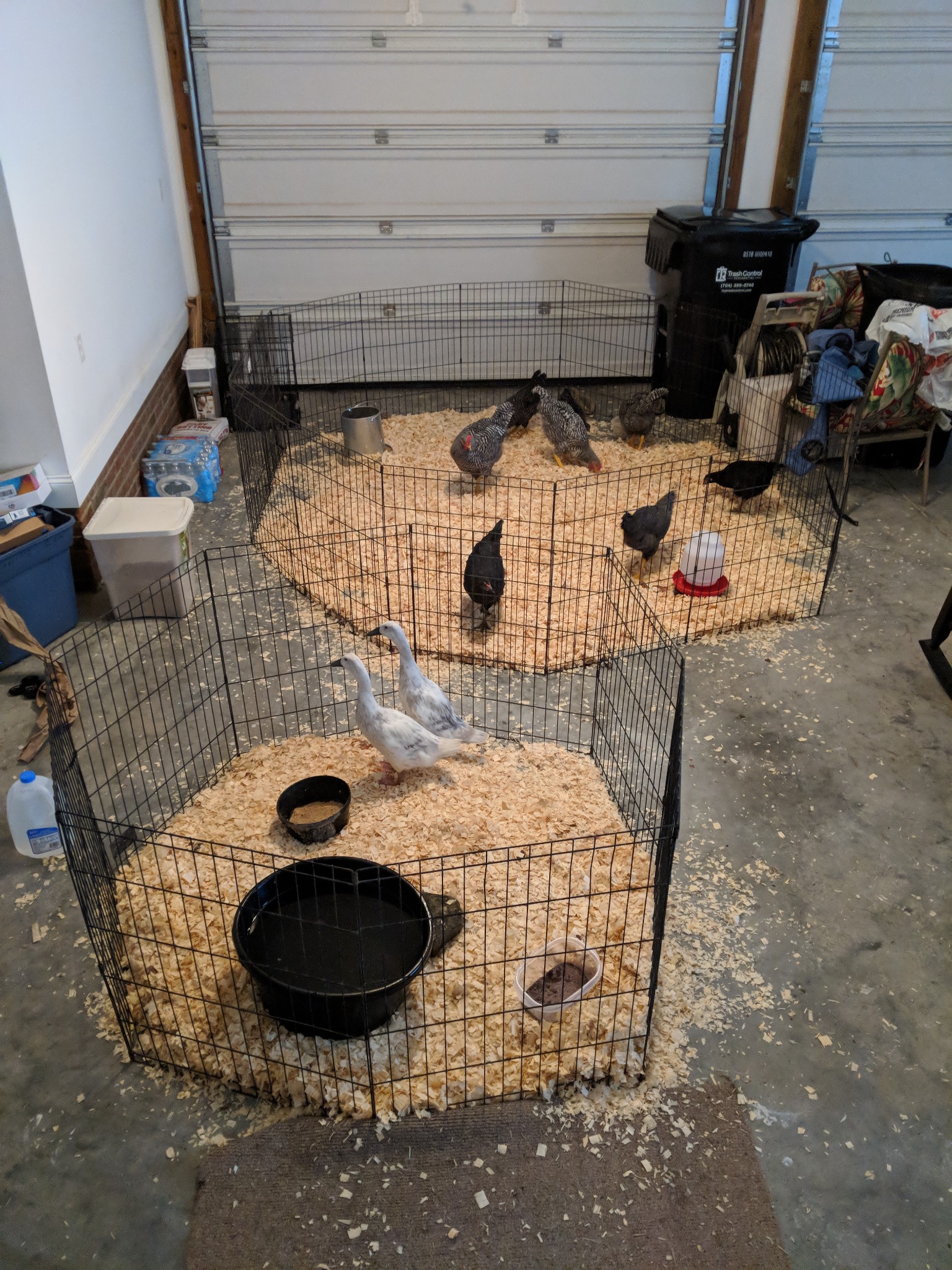
The last big events I think I missed were the hurricanes. Florence and Michael came through, but they did not hit us as badly as other places. Nonetheless, we did have some flooding and damage. We were very worried about the creek coming up towards the coop, and the winds were very high, so the birds got to have a slumber party one night.
I have thoroughly enjoyed our chicken adventures this year. We are considering adding peafowl or guineas, but I am not sure if that will happen. Our next big task here will be planning our spring garden and building raised beds, along with killing the fire ants, and some other projects. I’m going to try very hard to update the blog regularly in 2019, so keep watching, and I’d love your feedback and comments!
Merry Christmas!!!
Katie
 Jumping Dog Farm